Showing posts with label Guns. Show all posts

Monday, August 4, 2014

.308 Winchester vs. 7.62x51

This is pretty cool and a good look at an issue I know causes a lot of questions out there.

I have a rifle chambered in .308 and always just buy .308 Winchester but it sounds like I could have strayed and gotten into some 7.62x51mm if the price was right.

Thanks to BulkAmmo for look at .308 vs. 7.62x51mm ammo.

308 vs. 7.62x51

Wednesday, May 21, 2014

Good Guys vs. Bad Guys (with Guns)

I've posted about John Stewart before.

I hate to admit it, but I don't hate the guy or the show as a whole.

In fact, I watch it fairly often when I'm at home for the replay at 7 p.m. (Sorry, the first-run 11 p.m. is far too late for my lifestyle!)

It's a little preachy and often comes out pretty "progressive" for my personal taste.

But I think he's good at what he does.

With this latest commentary about the whole Chipotle situation... we pretty much agree. At least once you get through his snark and mocking of gun owners of the first 1:30 of the segment:


But wait, there's more.

It seems Stewart also had to weigh-in on "Smart Guns".

Apparently a gun shop owner in Maryland was getting threatened by 2A supporters because he was willing to sell Smart Guns.

I don't get it. It's probably the same class of gun owners that caused the uproar at the Dallas Chipotles.

Personally, I'm not a fan of Smart Guns but death threats to a gun shop owner for carrying a product isn't exactly what we need to be projecting as a community.

Wednesday, September 18, 2013

AR-15 vs. Shotgun

I know the rest of the gunblogs have gone off on this.

It's my turn.

I rarely watch cable news anymore. When I do, it's usually for a short period because I simply cannot stand it.

Monday evening, we watched for a while after dinner. I legitimately wanted to know more about what happened at the Washington D.C. Naval Yard and figured it was no longer a "breaking" news situation as Aaron Alexis had been dead for more than 8 hours.


I was wrong.

In the 20 minutes or so I could stand to watch the Erin Burnett program on CNN, we heard that Alexis used an AR-15 at least a dozen times. It sounded as if this AR-15 is a terribly dangerous gun and certainly not what my father or his father would use for a noble purpose such as hunting.

Then, Tuesday happened.

Alexis used a shotgun. Not an AR-15. Not the weapon the media has come to "know" and hate.

So. I'll turn to alternative ammo media to present a story about 5.56 and how it may be the "greatest caliber ever made"!


All jokes aside, prayers with those who lost loved ones and those who are still recovering from Alexis' paranoia-filled attacks. I certainly wish the men and women who spend their lives working hand-in-hand with our military the best.

Tuesday, July 10, 2012

Bring the pain

Long time no see.  My new pad doesn't have internet or cell coverage, so I'm in the stone age until I can get things sorted out.  On top of that I've been moving things, emptying boxes, and working my ass off in between.  There will be more blog delays, but hopefully not as long as this last time.

***

I finally got to do the first significant shooting yesterday since the move.  I say significant because I shoot rimfire off the front porch, but yesterday I put the first rounds through the .338 Win Mag, and made a good bit of noise.  What neighbors I may have in the surrounding area know I'm here.  To get the beast online, I picked up some steel Weaver rings to mount the beater Simmons 3-9 that I had sitting around.  It had been mounted to a muzzle loader at one time, so I figured it would take the brutal kick from the .338WM.  This setup will work during load development until I can put better glass and mounts on it.


First thing I'm going to say is that the concept of a lightweight magnum rifle is absurd.  I'm no pussy when it comes to magnum rifles; I was slaying critters with a 7mm Magnum on a regular basis before I hit puberty, so I know all about opposite and equal reactions.  Lately though it's become very trendy to have a pencil-thin barreled rifle with a featherweight composite stock chambered in a heavy recoiling belted magnum rifle under the asinine conclusion that it will be "carried a lot and shot very little," or "when I have to use this, I won't even notice the recoil!"

Well, hoist the BullShit flag, me hearties, and set sail for the Isle of Ghostah Reconfanboi!  We're going to plunder it for all it's worth and burn it to the ground!

Okay, what we're talking about here is a rifle that's so light it's comfortable to carry for days in the field, like you would to go hunting; and, presumably, since it's chambered in a magnum cartridge it's going to be fired in fear/anger at lions, tigers, or bears, or at the very least elk or moose, which aren't cheap to hunt.  So your telling me that you're going to take these .300, .338, .358, .458 Winchester Magnum "mountain guns," which weigh MAYBE 8 lbs. fully loaded with a scope, out to hunt either a once-in-a-lifetime creature with a $5,000 tag, or a monster bear with teeth and claws that will kill you in a moment, and you're going stake it all on your ability to shoot a rifle that recoils like a donkey punch to the soul?!?  Bad idea, hoss.  Bad idea.

Consider that when you're hunting "in the field," (DUUURRRHH!!!  When people say that I envision them in full Fudd attire, with their grey socks pulled up to their knees, wearing a fishing vest and big brimmed hat) you're likely to not be standing square to your target with the perfect cheekweld and the stock firmly in the pocket of the shoulder.  If you've ever settled for an ad hoc rest on a log, twisted in a precarious position so you can get that shot off at a deer, or taken a snap shot at game with a badly mounted gun you know that it's highly likely that the shot is going to hurt.  I've had a .243 Winchester bring tears to my eyes when I didn't have it mounted right, so what do you think is going to happen with something bigger?  I sold a Winchester Model 70 chambered in .300 Win Mag once that was one of these super lightweight guns, because she was a rowdy bitch and I wanted nothing more to do with her.  That thing was punishing to shoot, and because I shot it in "field" positions and not from a bench I knew I would never be a great shot with it.  It kicked way too hard and sooner or later I would develop a flinch (I have a video of me shooting it, but I can't load it right now).  Now though these guns are everywhere, and I think people are kidding themselves when they say they can shoot them when it counts.

My .338WM came with two boxes of 225 grain Hornady SST ammo, seven rounds of which had been fired.  A once over the gun brought me to the conclusion that these seven rounds were the only ones sent down the bore.  Let me tell you, after every shot with this thing I had to wait for my thoughts to return to my skull, like when you smack a video camera and it jacks the picture up for a couple of seconds.  If a bear was charging me I had better hit it well with the first shot, and it would probably be better if that round was the first I had ever fired through it, lest I fear the recoil more than the beast.  I shot twelve rounds getting it sighted in and confirming my zero, and the scope kissed my face with every shot.  The very next purchase for this thing is going to be the heaviest stock made, and I'm going to bed it to the action with lead.  Seriously, this thing should have a clevis at the end of the barrel to mount a boat anchor to arrest the recoil.

Keep in mind that I was shooting casually, from a relaxed position, and not snapping the gun up and getting off a quick shot.  People who say they can handle rifles like this (without developing a flinch) are full of it.  With heavy recoiling rifles you have to accept the pain before every shot -- that's a given.  You have to wait that extra second for your inner self's pitty party to end and the moment of flinch to pass, then you accept that it's going to hurt for a second while you make the shot count.  That doesn't happen when you fear permanent damage from the gun -- with the 5th shot yesterday I thought for a second that I might have cracked a rib.  Yeah, ouch.

Anyways, I have dies and brass on the way, but I have to have it delivered to my brother because there's no way a UPS driver is going down my creepy driveway.  I'm going to try to launch a 250 grain Berger hybrid at 2,800 fps without destroying the gun.  Where I live now, I can shoot basically anything I want in about 270 degrees around the house, out to 100 yards under limited conditions, so by this time next year I should be a handloading savant.  Unless I break my shoulder with the .338WM.

Wednesday, June 13, 2012

Open Carry AR/long gun protest in Detroit

From the ARs in the pictures, I see a POF P415 in the hands of the guy-with-the-flamboyant-shoes.  There's many folks though with ARs and a few with .22 rifles and shotguns, and of course there's one guy with a pistol strapped into a $12 crappy nylon holster.  Why spend $500+ dollars on a quality handgun only to wrap it into such a contraption?  Someone is going to make fun of you, so stop it.

A summary of the protest comes from the arrest of an 18 year old man who was carrying an M1 carbine on his back as the only means of legal armed defense.  From what I've read, the police and prosecutor are bending over backwards to make an example of this guy, who broke no laws, and the locals are showing how they feel about it.  Here's a thread with the details.  Be happy knowing that a new term has been coined out of this: Long Gun Open Carry, or LGBT LGOC for short, as what we definitely need in this world right now is one more acronymn that sounds like so many others.

My take on this is that if you expect the masses to follow statutes and codes to the letter, than you have to expect those who enforce said codes to follow them as well.  It's obvious it doesn't work out that way very often, but as you can see there are some folks out there who take it seriously, and it wouldn't profit to get them all worked up over what will amount to a mediocre funding stream from an 18 year old.  The law of diminishing returns still holds water last I heard.

Monday, June 11, 2012

The little Winchester Magnum that could

This weekend I was summoned to see a man's inherited gun collection that he was selling off.  I'm in a transitional period of my life right now that no longer includes buying firearms for the foreseeable future, so I vainly picked up an almost brand new rifle and pondered the possibilities, knowing I would have to set it back down.  My brother, who's generosity is only outmatched by his big heart, saw the spark in my eye and snatched victory from the jaws of defeat; he took that gun and set it in his pile so that I wouldn't lose the opportunity.  Thank you for that!

The rifle is a stainless steel Remington 700 in .338 Winchester Magnum.  My long range Savage 7mm WSM build is going on hiatus for a long while, but this gun will suffice in its place for a 1,500+ yard bullet launcher.  The reason I'm calling it the little WinMag that could is because this cartridge is generally not on the list of rounds for extreme long range (ELR) shooting; for a cartridge have this potential it needs to be able to drive heavy bullets at high velocities, which the .338 WinMag is not designed to do.  It was created to drive 180 - 250 grain hunting bullets at reasonably velocities, with the 225 grain bullets being ideal, to shoot large game out at moderate to long range.  To make for a ELR target gun, a cartridge needs to drive a 250+ grain bullet at really high velocities.  The .338 Lapua Magnum, for example, used by the US and British military snipers for long range work, drives a 300 grain Sierra Match King at about 2,700 fps, which is 200 fps faster than the .338 WinMag is capable of sending them.  Fortunately for me, I am in the business of making underdog cartridges perform better than they were designed to, and there's a lot of new technology in propellants and bullets that will help me do just that.  From my calculations, I believe I can get Hornady's 285 grain match bullet going fast enough to make hits up to 1,500 yards.  We will definitely see if that's going to work out before too long.


My picture is a little blurry, but as you can see it looks just like any other Remington 700.  The main difference is that you can drop a standard #2 pencil right down the bore.  In Virginia, having a bigger bore than .30 caliber is very rare, as anything larger than that is overkill.  The deer around here aren't much bigger than a fat coyote, so 100 grain 6mm bullets is really all you need (unless you plan on smacking targets at range).  This gun is going to be on an extreme budget, and I'll of course show my dear readers how it all goes together.  I haven't had a chance to fire it yet because of the extreme amount of corroded copper fouling that was in the bore, but I did manage with much effort to make the lands and grooves shine like a new nickel.  I doubt that the barrel has seen an entire 20 round box of ammo in its life so far, so it has some mileage left on it.

My brother's reward in all of this is a .22 rifle that shoots bugholes, some other really cool longarms and handguns, and this beauty that he got for a price so low that I don't dare mention:


It shoots great!  As far as I know, he hasn't done any extensive shooting with it to find out what ammo it likes the best, but I can say that I would carry it without hesitation.  I can also see why the snub nosed Colt was favored so much, as it's a joy to shoot. 

It was a great weekend, and I am truly blessed.  Things may be hit or miss around here for awhile, as my family and I are looking to find and move into a bigger house.  We've been fighting to stay in the same tiny little house that we bought when we were first married and didn't have any kids, and to tell you the truth I'm well past tired of putting up with it.  I'm over being bombarded by boxes and stuff that falls out of every cabinet, with random things piled on top of every nook and cranny, and it's high time we went somewhere else.  If the good Lord spares my life, I'll be hung up with this and that for the next couple of months, so if my posting falls off please come back and see me from time to time.

Friday, June 8, 2012

That's not a gun. This is a GUN!!!

Known on US Navy ships as the Close In Weapon System, or CIWS (or Phalanx), in Iraq somebody had the totally awesome idea to mobilize them and use them at ground facilities for. . . . . wait for it. . . . shooting down rockets and mortars!  Wicked!!  This version is goes by the much cooler name of Counter Rocket, Artillery, and Mortar, or C-RAM.  Other countries have 30mm and 40mm versions, but the US CIWS/C-RAM is a 20mm gun.


Rate of fire for the latest system is reportedly 4,500 rounds per minute, and doing the math shows that to equate to 75 rounds per second!  That's nasty.  I guess it has to be to be able to shoot football sized objects down from several miles away while they're traveling at 3,000+ feet per second.  I didn't have this system where I was at, so all incoming rounds just landed wherever, but I would have been glad to have this beast shooting stuff down.  Now I wonder how much each round costs so that I can calculate how much a four second burst costs.

ETA:  And another one that shows thermal imaging where you can see the actual mortar taking hits and blowing up from the 20mm rounds. 

This one's even better!


ETA:  All right, so apparently this concept is way more high tech than the CIWS/C-RAM system.  The Germans have a 35mm "Revolver" that is way cool at shooting down incoming threats.  Hang in there towards the end of the video to see what the rounds do to missiles and such.  Awesome!

Thursday, June 7, 2012

OWB Holster for "the outdoor woods"

A little throwback to Over the Hedge there in the title if you didn't catch it.  Yes, I watch too many kid's movies.

Anyways, this past weekend was the annual river float trip that friends and family faithfully take, and since I've missed the last two I made sure I was there.  In preparation, I made a kydex OWB holster for the P30 because rowing a canoe for two days with a pistol tucked down by the crotch didn't sound like it would make for good times.  This type of holster is super easy to make -- without the given interruptions in my house it probably took just under an hour total:


Retention is excellent, and there was no need for a strap, snap, or other retention device. In light of a friend's previous river disaster, I did attach a BLACKHAWK! pistol lanyard so that if the gun or gun/holster came loose for any reason I would have a way of not losing it for five years. Unfortunately, a gigantic thunderstorm made us give up on going to the river, and instead we went to a remote campsite on private property on a nearby reservoir. That turned out to be a smart decision because the night the storm hit the river rose six feet in four hours.

I did manage to end up on the wrong side of the canoe's gunwale close to the bank, and wading around in silted water showed the inferiority of the beach-sand-torture-test, as the insides of the P30 were thoroughly coated in it. I don't know if the gun would have fired or not, but it certainly was hard to rack the slide. I did have a cleaning kit and SLIP 2000 to make her smooth again. Overall though the holster held well and protected the gun from bumps and bruises. I'm really enjoying this holster making stuff!

Tuesday, June 5, 2012

MMmmmmm. . . vintage!

The M16A2 is now old enough to be considered vintage, right?  ARFCOM has an A2 picture thread going to show all the plastic handguard haters what old school looks like!

I know all the M4 types love the look of the carbine in all it's CQB glory, but back in my day a "battle rifle" wasn't limited to 300 yards or less.  600 yards isn't a big deal for the A2 with serviceable sights, and the Marine Corps still to this day shoots out to 500 meters.  Despite the flood of optics, lights, lazers, and doodads that adorn the AR type rifles these days, I still think the good ol' A2 rifle is sexy.  I can remember a certain day in Kuwait while waiting on a trip to the airport, some Soldiers were snickering at my M16A2 with its well worn and shiny receiver, sans an optical aiming device.  They all had M4's, and a couple of them had the M16A4, which I didn't even know existed at the time.  Each one had a $500+ optic sitting on top of it, which was a marvel to me that the Army had the coin to buy every Soldier an Aimpoint, from cooks to high-speed infantrymen.

On my list of guns to get is an A2 style AR, but it's going to have to wait for a few years.

Wednesday, May 30, 2012

More AR parts

I received some parts in the mail yesterday from Bravo Company USA (BCM) that I ordered for the AR upper build, and unfortunately I forgot to load the picture of them I took last night.  I went ahead and picked up BCM's own bolt and carrier set so that they're matched; normally I like to keep the bolt the same brand as the barrel, but right now there's not a single Daniel Defense bolt out there.  Reading about the BCM bolt and carrier, they fire one high-pressure test round with the bolt and then do Magnetic Particle Inspection to look for any cracks or flaws.  This gives peace of mind that the bolt won't fail when you need it most, which is worth it in my book for the ~$30 extra you pay for it.

I also picked up a BCM Gunfighter charging handle, the medium latch one, and to say I'm impressed is an understatement.  I will be buying one of these for the little-AR-from-DPMS, and every AR I own thereafter.  Super piece of gear.  I did a comparison by feel of a standard charging handle vs the Gunfighter, and the Gunfighter is much more solid, slick, and really does feel like you're side-charging the gun.  For $44 it's a bargain.  With that said, a Mil-Spec charging handle will do the job, and has been in combat, but the added grip given by the Gunfighter and mental insurance that it has more metal to it and won't break when you're yanking on it is worth it.  Also, if you're running a scope on your AR, it's really helpful to be able to charge the gun from the side vice doing the two-fingers manipulation using your index and middle finger which is a pain.  Go here if you want an in-depth review of the BCM Gunfighter charging handle that includes comparison pictures to a mil-spec one, and here if you want to see visual confirmation of a failed mil-spec charging handle.

Next up is an optic, and then I'll be putting rounds downrange.

Thursday, May 24, 2012

Wednesday, May 23, 2012

Dropping the case

The Marine Corps and Army are developing new caseless and case-telescoped ammunition that, when partnered with a new light machine gun also in development, could significantly cut the burden on troops in combat. And perhaps more significant than that, in the coming years this revolutionary ammo could drive production of the Corps’ next service rifle.
With modern technology, caseless cartridges don't look like they're far off.  Unfortunately, in order to get the Service buck$ to fully develop it, they have to run the gauntlet and survive the slayer of programs: a.k.a. the Acquisition Wall Chart.  Folks can whine all they want to about the cost of weapons systems, defense spending, and how icky contractors are pissing away US dollars, but it's my firm opinion that the atrocious wallchart of death is to blame for the inefficiencies, and it was created in a university and has been lovingly nurtured ever since into a dollar-eating leviathan.  The wallchart of doom is a mire of acronyms and techno-terminology that nobody can possibly understand, but they all act like they do just the same, and it swallows programs whole.  I hope new small arms programs survive the beast and grow into something beautiful.  I really do.

Back to the story though, the concept of caseless ammo is not new, and the challenges associated with it are well known.  First thing to understand is that when a brass cased cartridge (or plastic shotgun hull) is fired inside of a chamber, it seals off the expanding gasses at the chamber end which aids in velocity of the projectile down and out the muzzle.  Caseless ammo has to overcome this hurdle.  Secondly, when the case is ejected, it takes heat with it -- which it's good to expel the heat and all, but it also is mechanically complicated to have an ejection system in the first place, which is a major cause of malfunctions.  So that part is a double edged sword.  You may have heat problems (almost certainly), but you should have a huge boost in reliability since there's no expended case to eject, and less moving parts in the system.  The remedy for the heat issue may be in the use of a modern propellant, and I have no idea on how they would tackle the gass-sealing issue.

The main reason though for caseless ammo consideration is a reduction in weight.  This also is a double edged sword because, as veterans will attest, a reduction in weight in one area translates to an increase in weight in another.  Guaranteed.  You read it in articles all the time about "reducing combat weight for the poor overburdened Soldier," but that's all just a bunch of bullshit in reality.  Somewhere, in a secretive and non-descript room in a huge five-sided building, some heartless yayhoo with an evil laugh has a magic number bayoneted to the wall that shows the total average weight an 18 to 20ish American male in good physical condition can carry for four days without dying from exhaustion, and they approve a certain amount of weight above that number.  The upside is that you get to tell the Warrior that the reduction in weight will be filled with a corresponding increase in killing potential -- that will go over well, or at least much better than telling him or her that the weight will be made up for with sandbags or some other equipment -- batteries -- that won't be as useful for slaying enemies.

I'm all about caseless cartridges.  In fact, I'd kinda like to try my hand at reloading them, considering my addiction and all.  Instead of resizing brass cases until my fingers bleed, I could be molding my own rounds out of putty-like propellant on a miniature pottery wheel. . . . like in Ghost!  It would definitely be better for my nails!

Tuesday, May 22, 2012

82nd Airborne in Afghanistan

About 80 high resolution photos of the 82nd Airborne kicking ass in Afghanistan at theBrigade.  (***Graphic: blood)  There are about a half dozen photos of a Soldier carrying a suppressed Remington MSR with a Premier Reticles scope.  While I think it would be fun to shoot that rifle, I don't think I would want to carry it.  I've handled a suppressed one before, and it's a beast.  There's also a M110 sniper rifle in there, and I can't help but to laugh at the massive Trijicon ACOG on top of a M240 machine gun, with a huge reflex sight mounted on top of that.  It's like something from Doctor Seuss; the reflex is at least six inches above the bore, and closer to eight inches.

Assembling an AR-15 Upper

The 11 day shipping on the carbine length gas-tube finally ended yesterday so I got to put together my AR upper.  Total time for assembly was just over two hours, but that was with constant interruption from the beast with two (now 3.1) crowns and the beast who torments with the Corn Popper.  Dinner time was also in there, so my guess is that without interruption the build would have taken about 40 minutes. Don't be intimidated to assemble one yourself; ARs are basically legos for grownups, and each part snapped or bolted on holds on another part. Here's a blow-by-blow with pictures on how to put one together. The forward assist is held in place by a roll pin. I use roll pin punches (from Brownell's) because they don't mangle the pin.
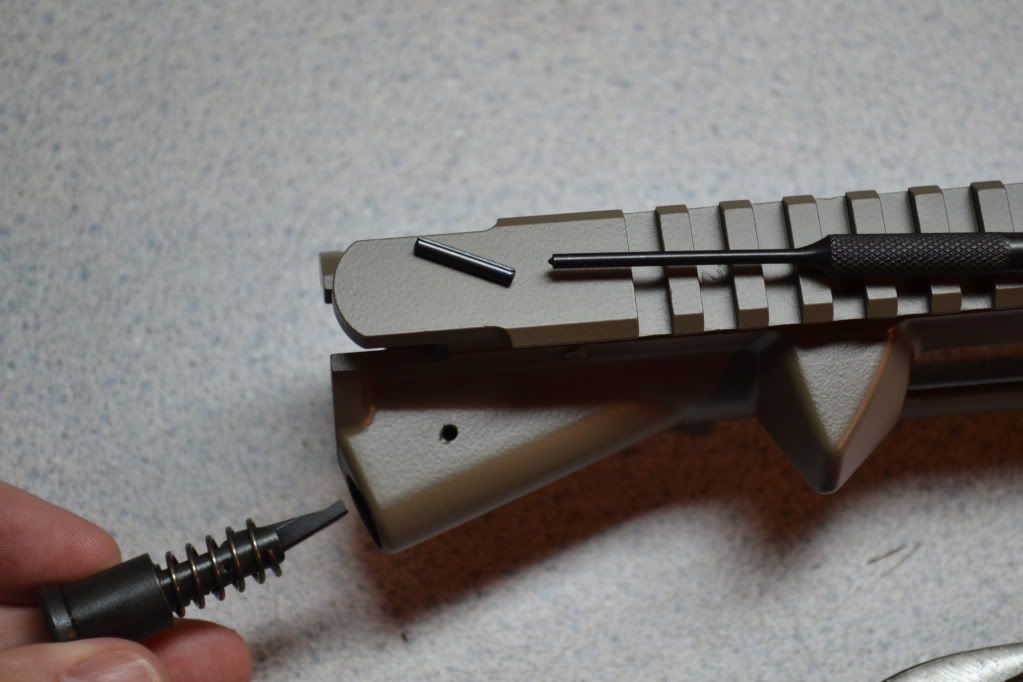
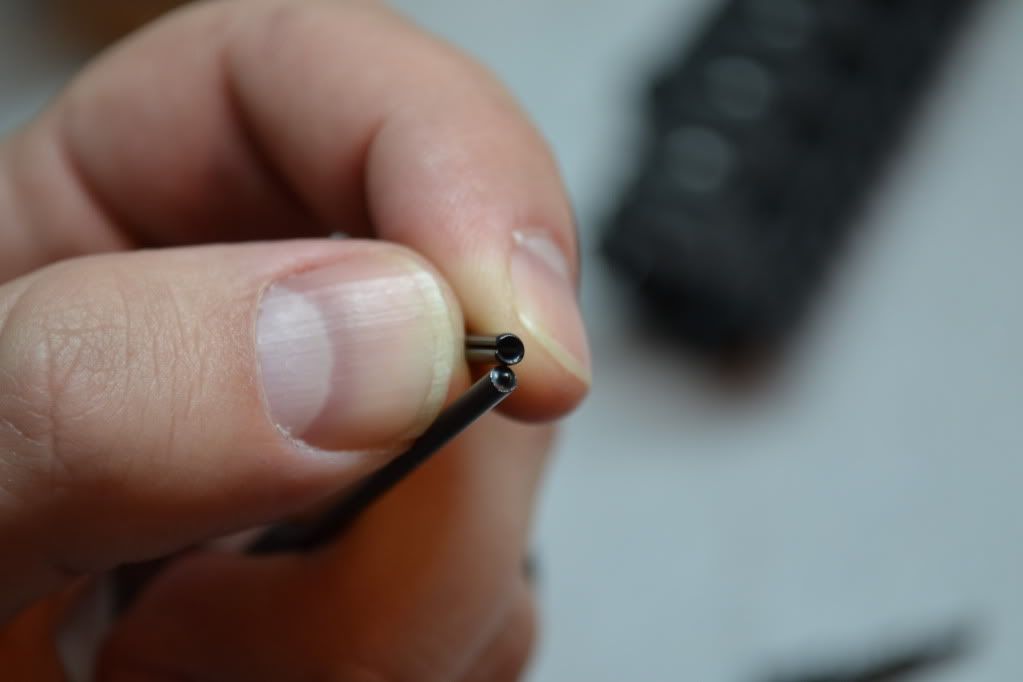
The forward assist goes into the big hole, and the roll pin goes into the conspicuously sized small hole there on the top. If you don't have three hands, get the roll pin started first before pushing the forward assist in (push it in as far as it will go before driving the roll pin all the way in). Some AR uppers don't have a forward assist, but they don't really add much more cost and you would be surprised at how useful it can be to quietly chamber check while in the woods and know that the bolt is seated. I bought the forward assist with spring and roll pin for like a whopping $16.

Next up is to install the ejection port cover. The ejection port cover pin has a small C-clip on it (one on the right) and you can see the notch where it goes (one on the left):
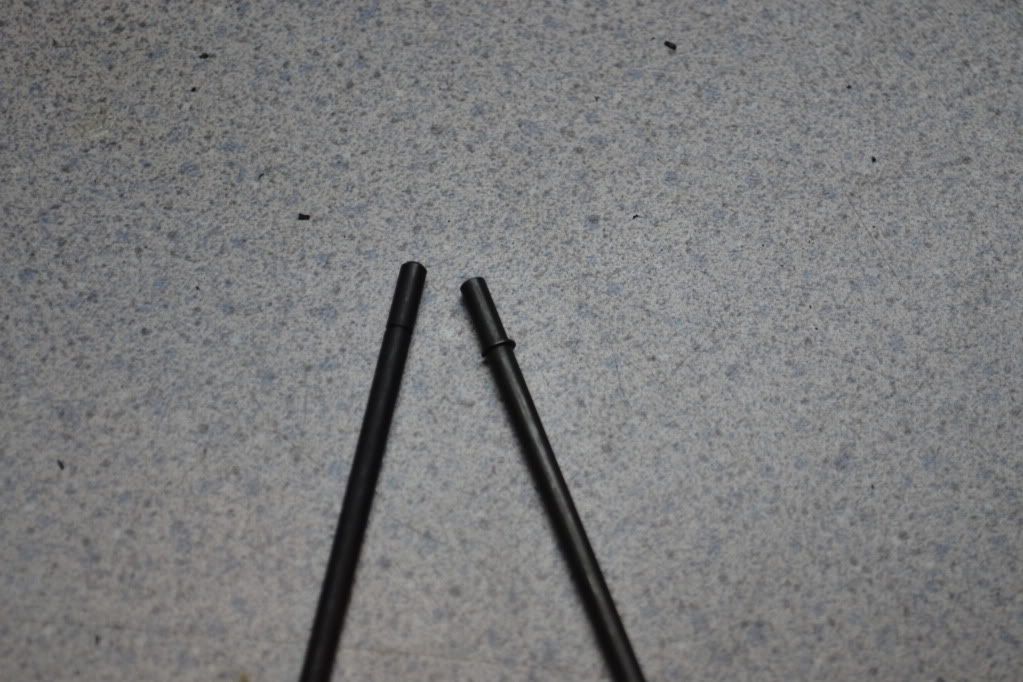
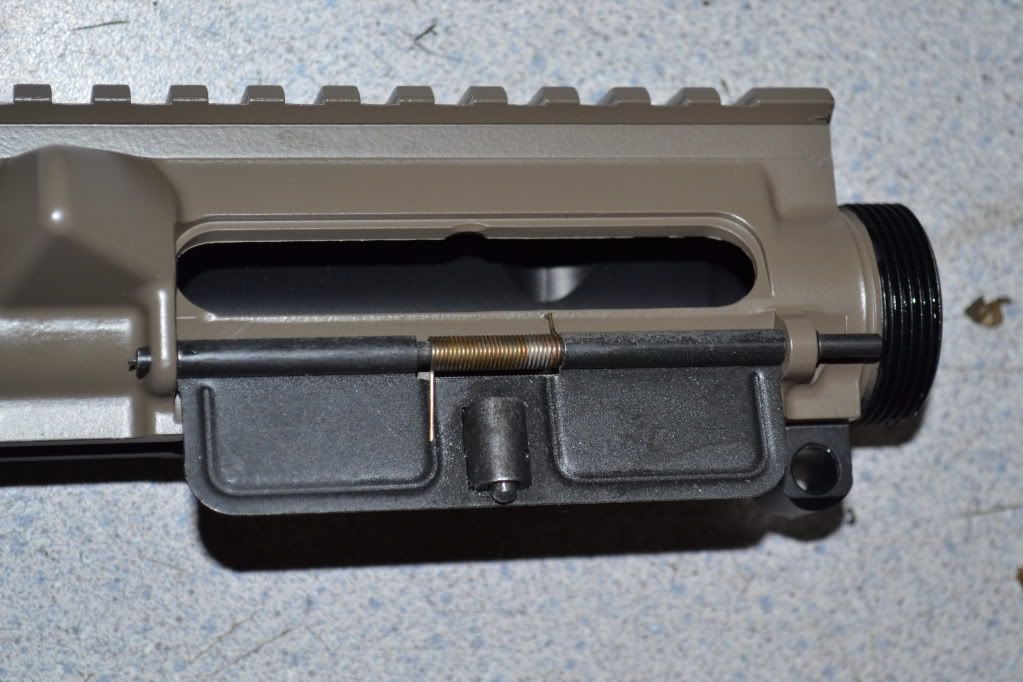
The C-clip side of the pin points towards the front of the receiver -- it just slides right in. As you're looking at it in the below picture, it goes in from the right to the left.  The C-clip is on the right side of the pin.  Start it through and then add the port cover, with the spring going in the gap. Putting the cover on takes about ten seconds total; you just have to be sure that the long tab on the spring goes against the door and the short tab goes against the receiver (looking at the spring in the picture, the long tab of the spring is on the left side and the short tab is on the right just below the ejection port):
On to the gas block and gas tube. There's a single roll pin that holds them both together; take a moment to slide the gas tube into the gas block to see how it works; there's two holes on the end of the tube that correspond to two holes in the gas block -- small holes align for the roll pin, and the larger holes align to allow burned propellant to flow through them and operate the bolt.  ***Notice the gas port on the gas tube is facing towards the bottom of the picture.***  When you assemble this beast, that gas port faces down towards the barrel:
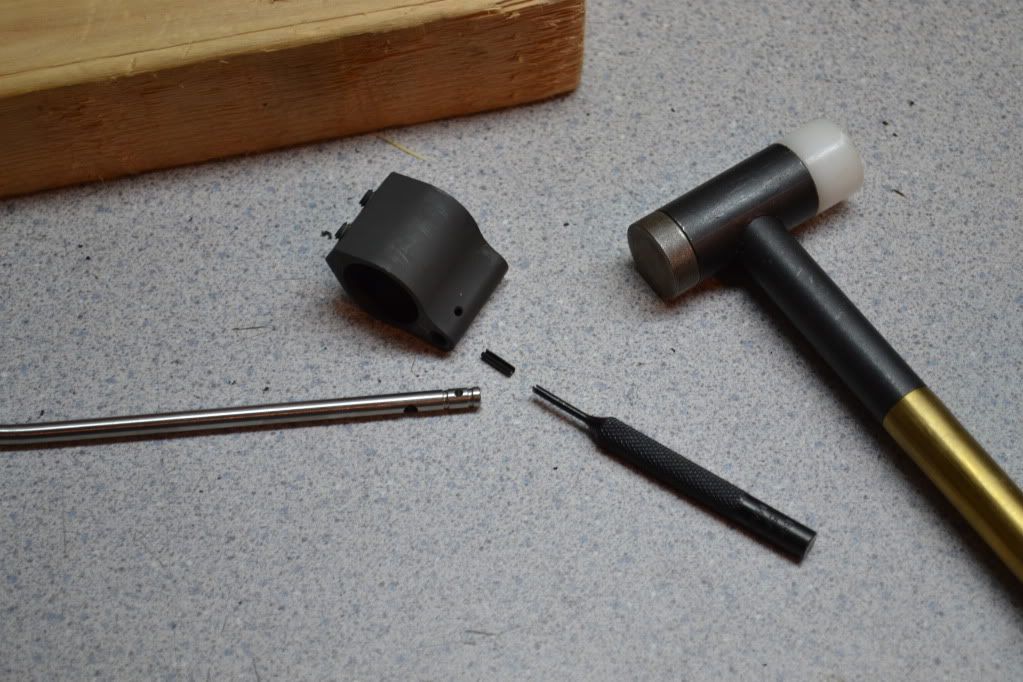
Before I install the gas tube with the roll pin, I measure the center of the big hole on the gas block and scribe a line to help me line up the gas block on the barrel (the side that faces away from the receiver, towards the muzzle). It just has to be a visible mark, and you can use a pencil or sharpie instead of a scribe:
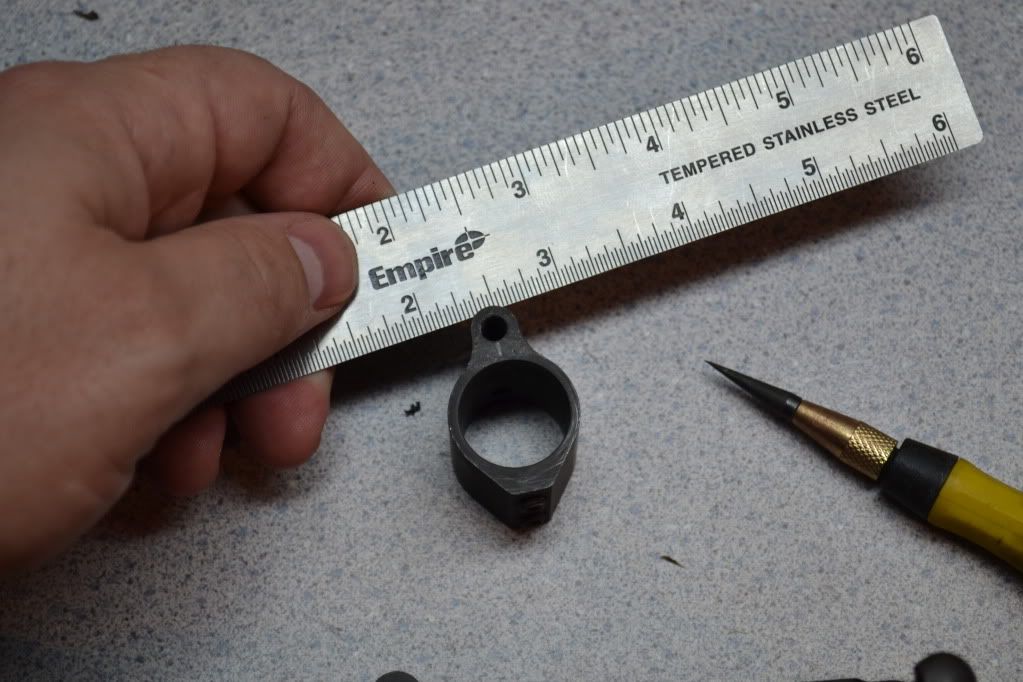
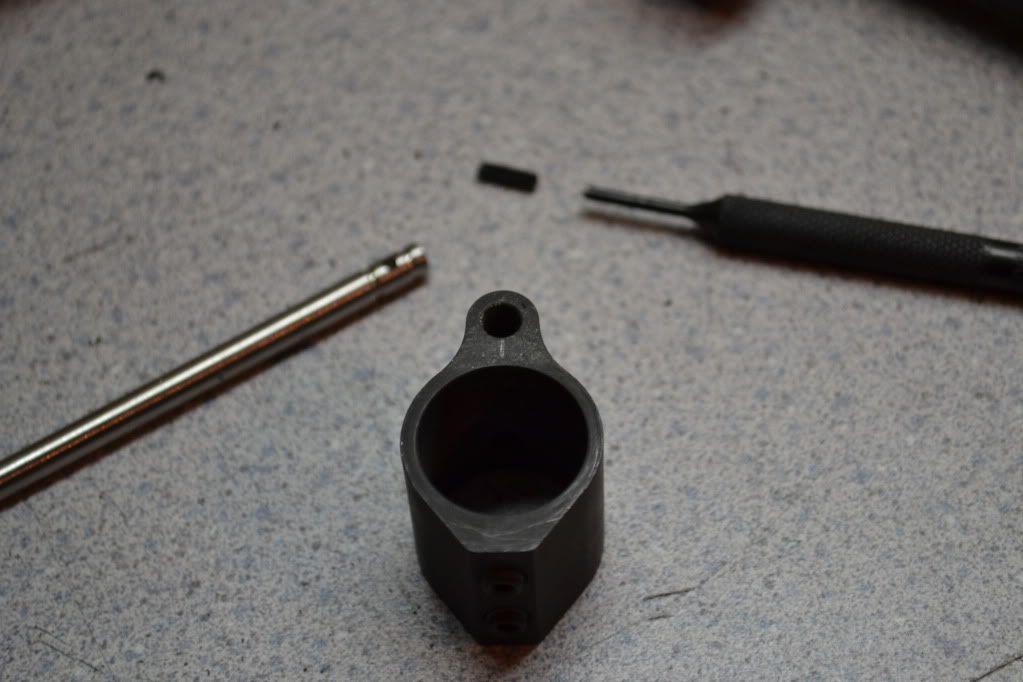
You'll see the reason to add that index line in a few minutes. Unless you have five hands, it's best to find a way to secure the gas block while you drive the roll pin through:
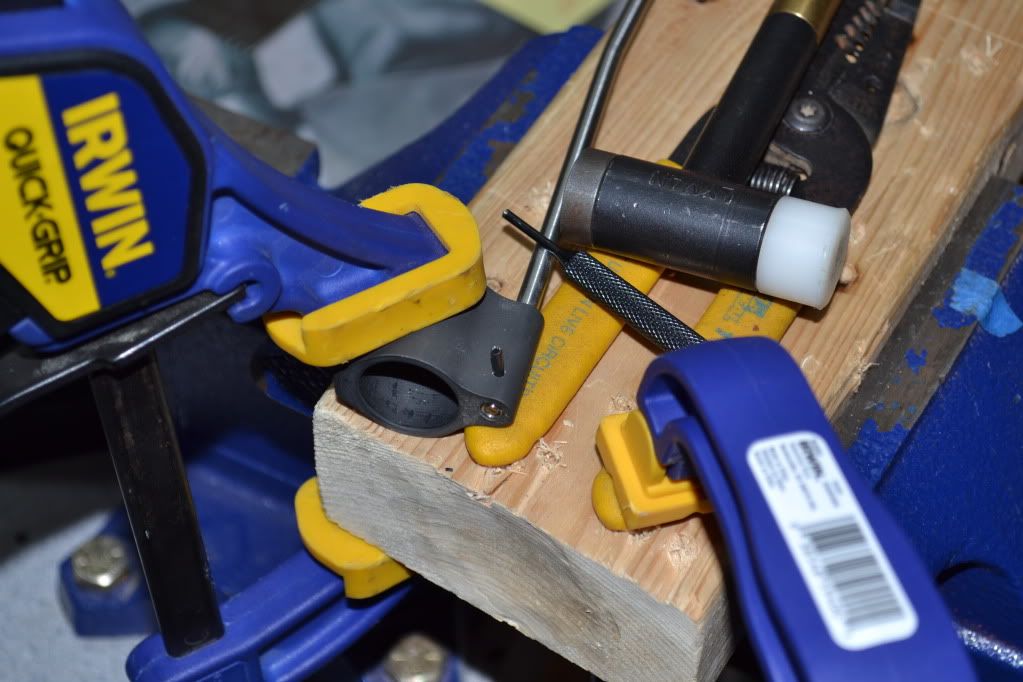
"WE HAVE WAYS OF MAKING YOU TALK!! MOOHOOWHAAHAHAHAHAH!!!"

This part can be a pain in the ass. Here's a pro-tip: while you have the gas block clamped down (be careful not to crush it!), push the gas tube in until the roll pin holes are aligned (be mindful of the ***gas port on the tube -- you want it facing the gas port on the inside of the gas block (as you can see it in this picture, it will be facing LEFT)) and then mark a line with a sharpie right where the tube enters the gas block. When you start tapping on the roll pin the tube will slide in and out, and it's a bitch to get things lined back up without an index.

On to the barrel installation. It's best to have a receiver block to secure the piece in a vice for assembly. I've gotten away without one before using two pieces of wood and a vice, but I don't reccomend it because if you're not careful you can crush your receiver. It's also not very stable. Either way, once you have your receiver settled in the vice, grease the threads (ONLY THE THREADS!! -- DO NOT get grease inside the receiver where the barrel extension goes!!)
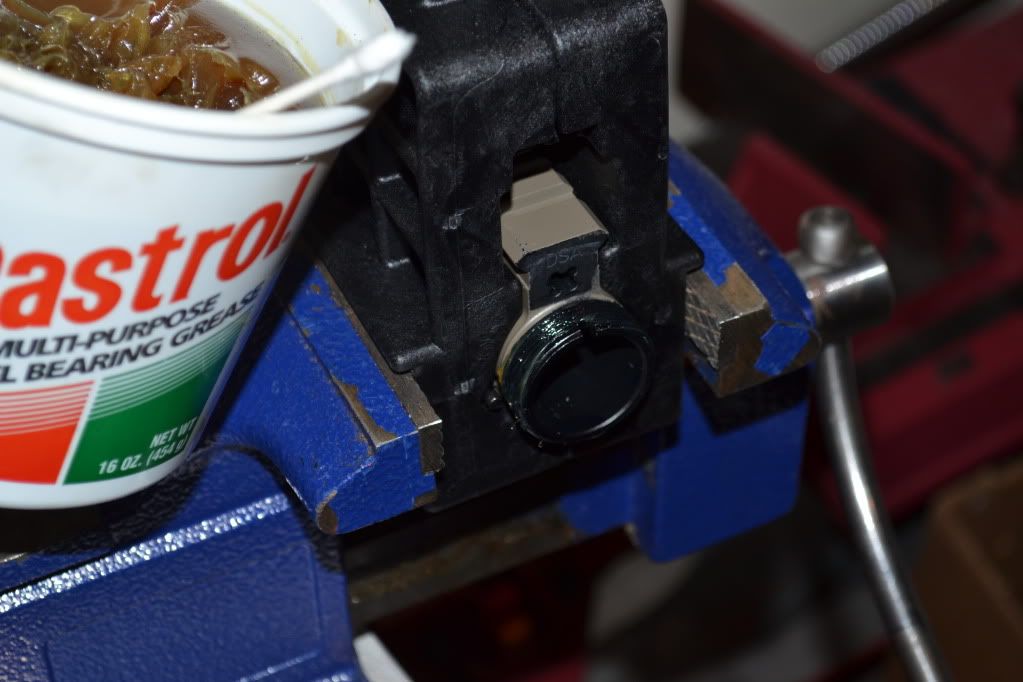
I have had good success so far using Castrol wheel bearing grease and applying it with a Q-Tip.   The barrel extension fits into the big threaded hole in the receiver.   Here's another pro-tip that I have independently verified that works great for maintaining accuracy when the barrel heats up: it's good to "bed" the barrel extension to the receiver.  Benchresters use shim-stock, but you will probably have to order it; I use locktite, and it works fine and has improved my groups when the barrel warms up.  Here's how it works:
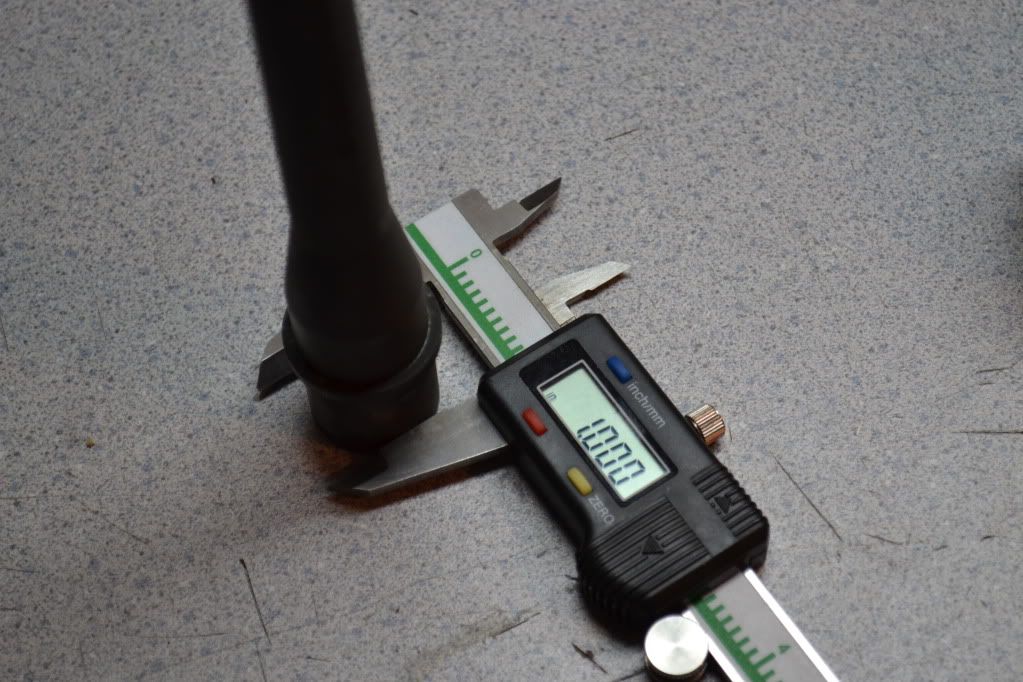
The outside diameter of the barrel extension on this barrel measures a clean 1.000", and the inside diameter of the hole where the extension is going to rest for the next 50+ years measures 1.002"
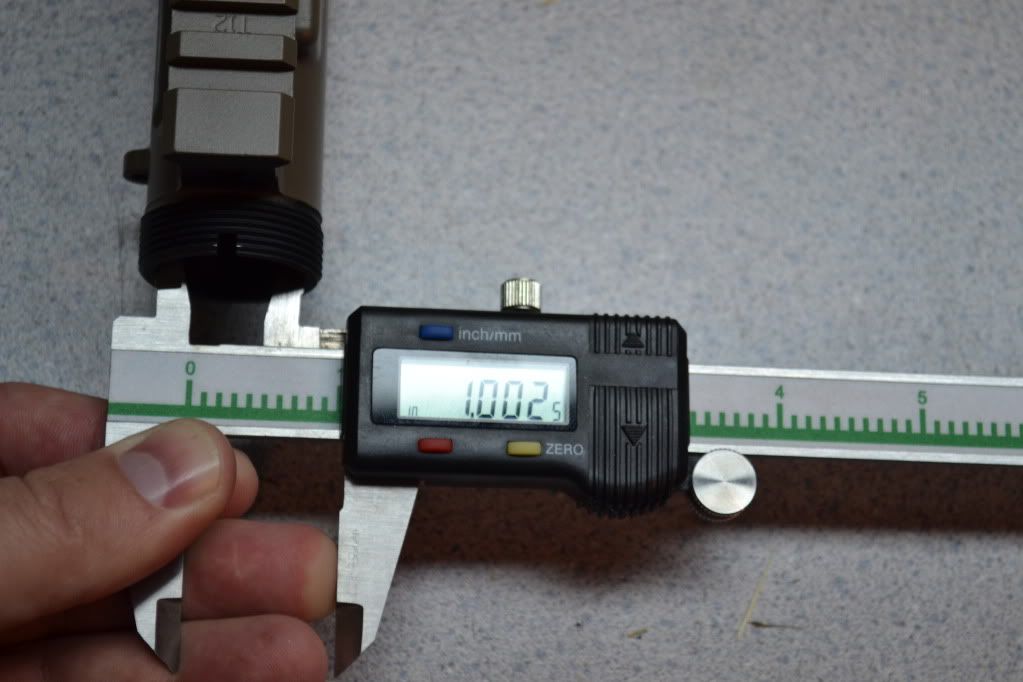
As far as AR receivers go, this DS Arms receiver is machined pretty tight. Some are not. The Les Baer receiver and barrel extention that's in my MK12, for example, was machined to tolerances my calipers couldn't even read to, so it didn't need to be bedded.  When the steel in the barrel and extension heat up from firing, and when the aluminum in the receiver heats up, the metal expands, which can make your groups shift.  By filling in the available space with Locktite or shim-stock, you're taking away that option.  My group SIZES will still open up some when the barrel gets hot, but the point of impact does not shift. 

With that said, I did bed this barrel extension, but you don't really have to if you don't want to.  No biggie.  To bed it with Locktite, you slather the outside of the extension and inside of the receiver where it contacts (I prefer blue Locktite for this), using your finger to get it even:
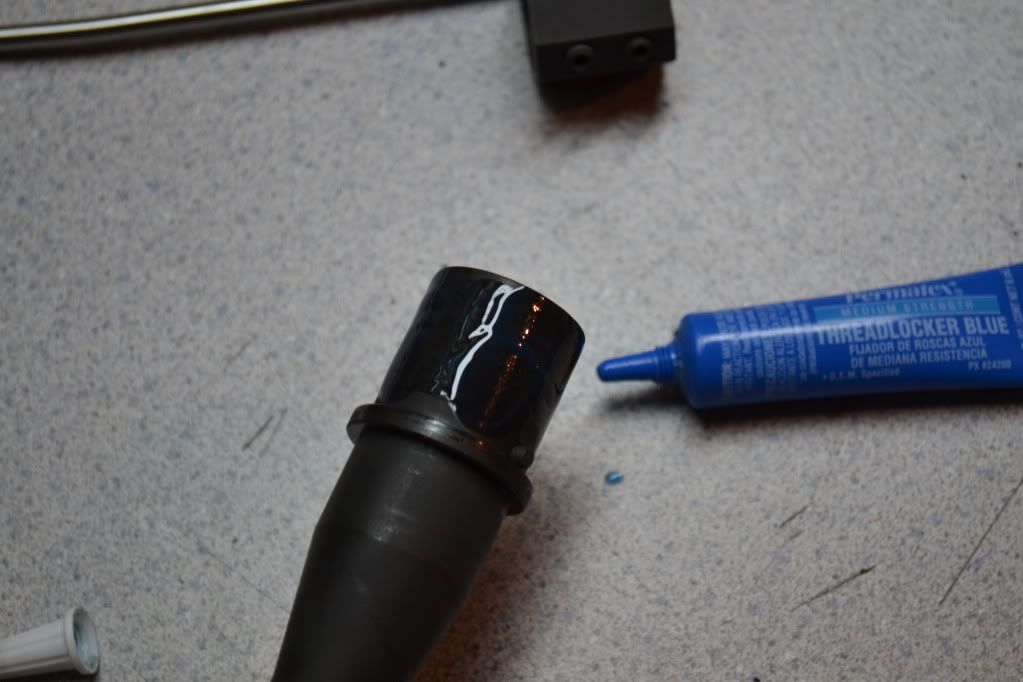
Now, WHILE THE LOCKTITE IS STILL WET, slide the barrel extension into the receiver, making sure to line up the indexing pin on the extension with the notch on the top of the receiver where the threads are. Hand tighten the barrel nut:
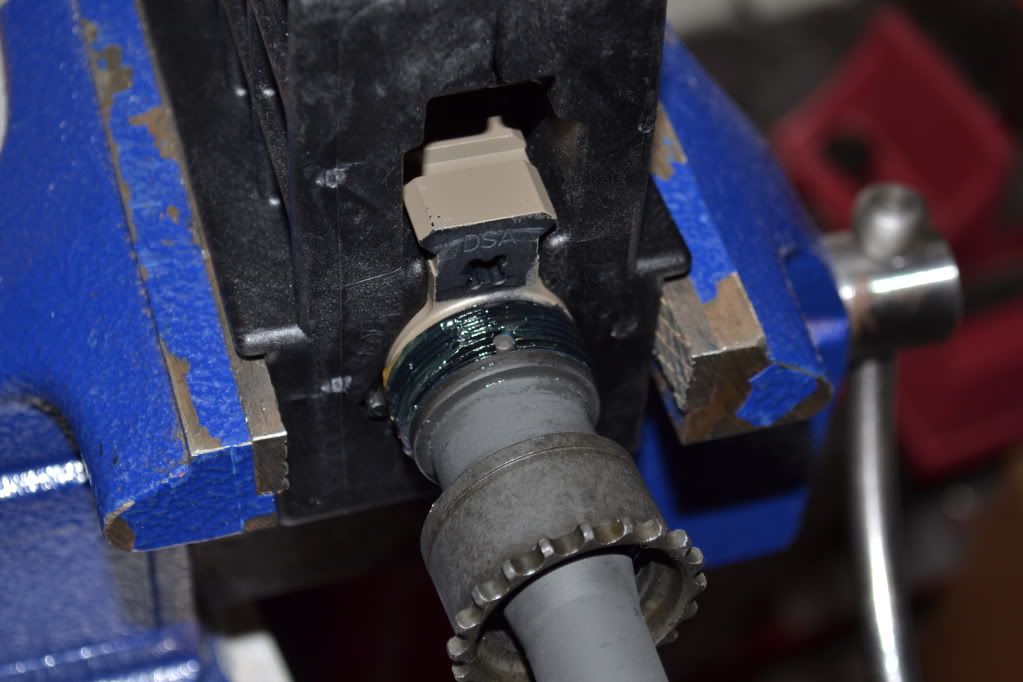
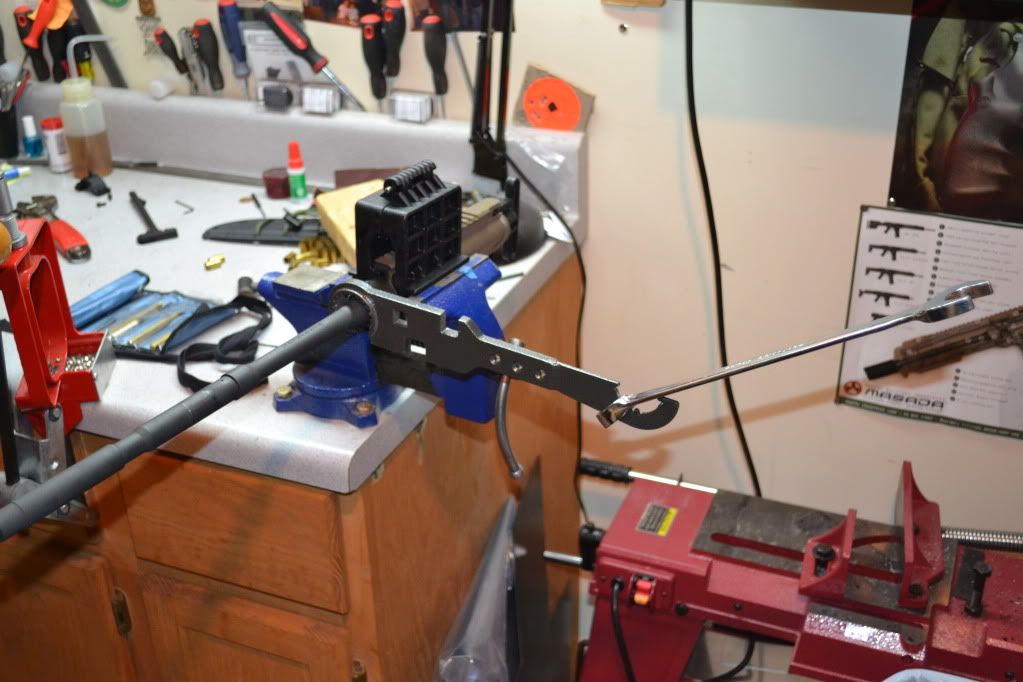
Tighten the barrel nut with an AR-15/M16/M4 barrel nut wrench; you want to do this three times to mate the threads together. So you crank it down (40 to 90 foot pounds if you have a torque wrench); loosen it up; crank it down; loosen it up; then crank it down tight again. I don't use a torque wrench because you have to line up one of the notches in the barrel nut to allow the gas tube to go into the receiver (you'll see in a minute), which means you may have to loosen the nut a bit to find a notch. I go by feel, keeping in mind that the receiver is made of aluminum and you can strip it or wring it off. I weigh just over 200 lbs, and I put about a 3rd of my weight into it WHILE SUPPORTING THE RECEIVER WHERE THE BARREL AND RECEIVER MEET with my left hand. I basically torque the end of the wrench downward with my right hand with most of my strength. The reason to support the barrel/receiver is so that you're not torquing it downward; the pressure from the wrench should only be going into the nut and the threads in a clockwise direction. If the end of the nut wrench is thin like a butter knife, or if you're a girl, you can hang a large wrench onto the end of it to give you more leverage:

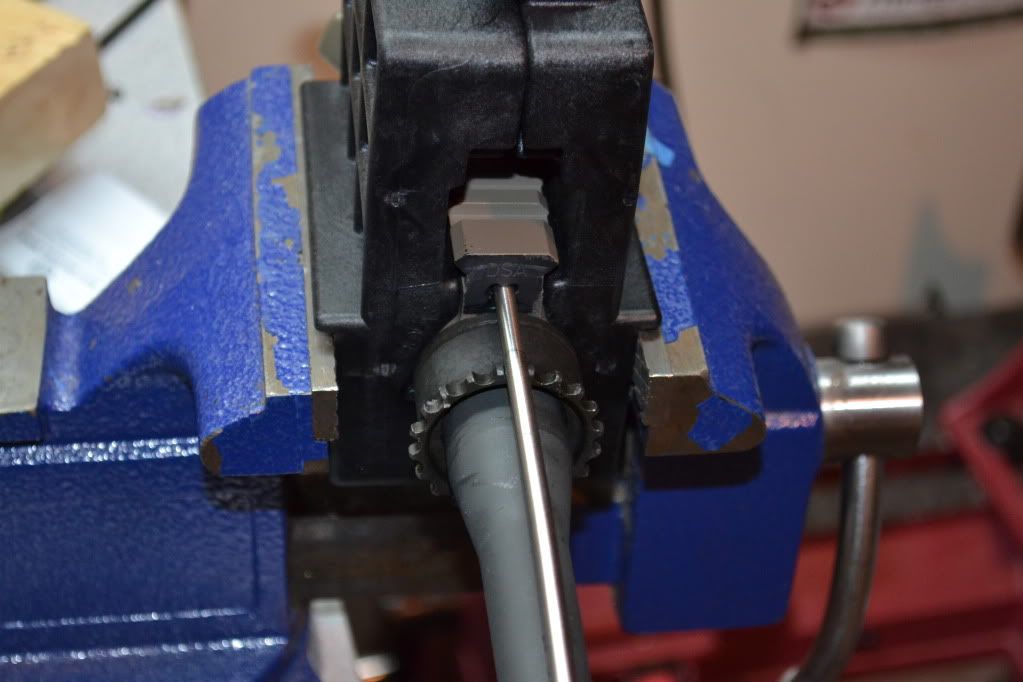
Once it's Gutentight, try the gas tube to see if it lines up okay. If it doesn't, then you loosen or tighten the barrel nut until the closest notch lines up. You want there to be a little side to side play at the hole where the gas tube goes into the receiver. That's important, because the bolt carrier key slides over the end of that gas tube inside the receiver, and if it doesn't have room to wiggle a bit the bolt carrier will chew it to pieces and your accuracy will suck:

This is a good place to stop, take the receiver out of the vice, and clean out the still wet Locktite on the inside of the receiver where it squished out from under the barrel extension.  Use a Q-Tip or something to that effect.  If it has dried, try some rubbing alcohol or mineral spirits.

Now to install that gas block/gas tube assembly (hereinafter "assembly"). To make sure the gas port on the barrel is aligned with the gas port on the assembly, I scribe a line on the barrel to index with that handy dandy index line I scribed on the gas block. Don't scribe too deep (or use a pencil or sharpie):
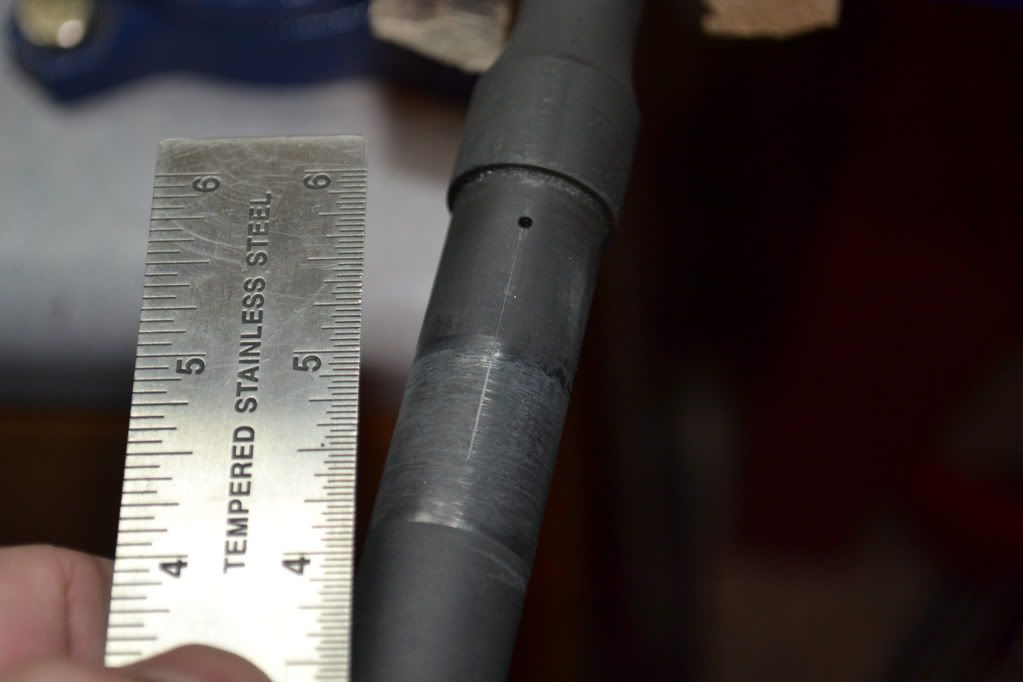
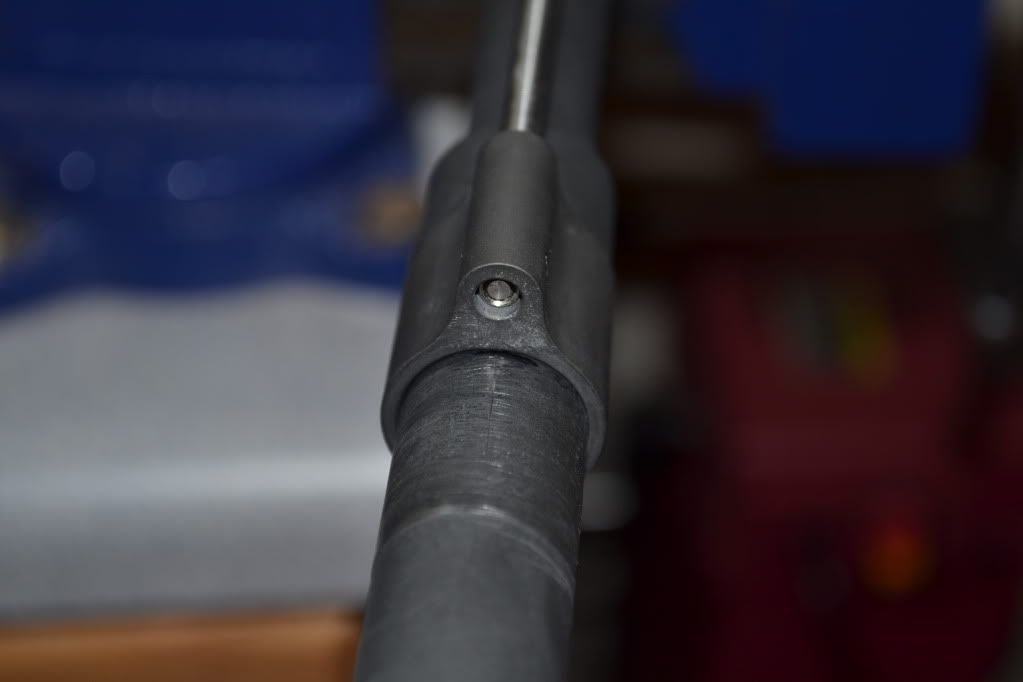
That last picture is not the best, but the two scribed lines line up. I've never had a problem lining them up this way. The gas tube now runs down the barrel and runs into the receiver like the picture three pics up. There's room for it to wiggle and everything is grand, so at this point I Locktite the two screws on the bottom of the gas block and tighten them to 20 inch pounds. Not all gas blocks are the same, so I skipped on the pictures on how it's secured. It's a Troy brand gas block and it has two hex screws that hold the thing on.

Moving on to the flash hider. There's all sorts of flash hiders, flash suppressors, muzzle breaks; I don't have much problem taming the fierce recoil of the mighty 5.56 NATO, but I'm also not planning on competing with it. I opted for the $20 standard issue A2 "birdcage" muzzle device thingy, and to install it you need a crush washer. The crush washer is shaped like a cup, and the concave part faces the muzzle threads and the A2 thingy screws down onto it:
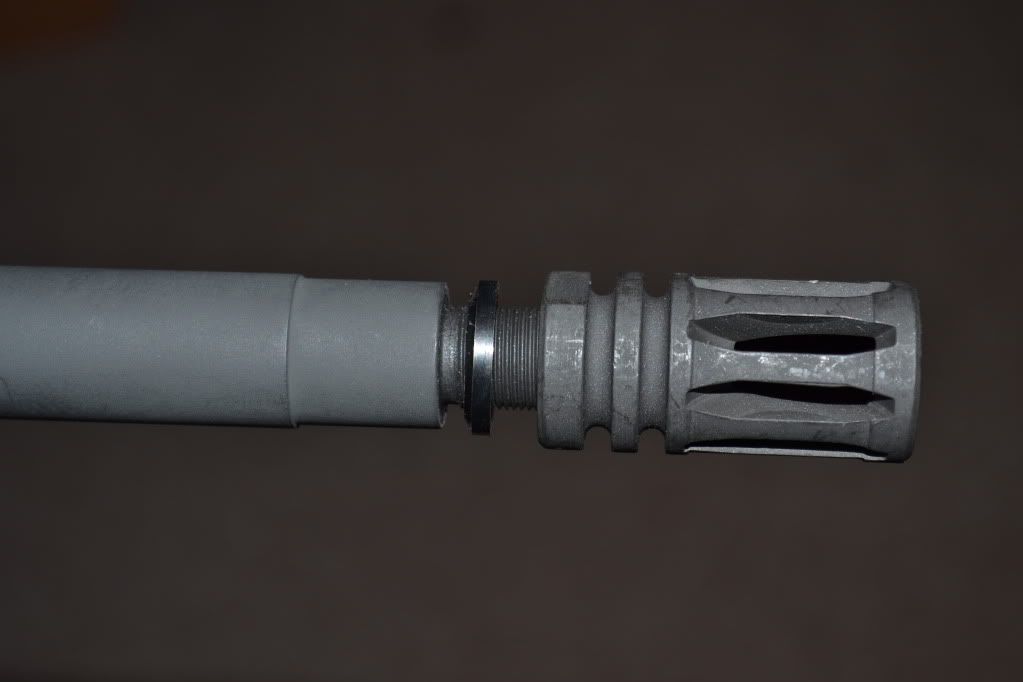

I'll admit that this part can be terrifying; a crush washer is called a crush washer because it crushes when you wash. . .er. . .tighten a barrel device against it. Isn't that clever? It takes quite a bit of effort to do it, which makes it feel like you're about to wring the end of the barrel off. It's purpose is to properly "time" the muzzle device; that is, to make the slots/ports at the end of the muzzle device point up, which leaves the closed portion of the muzzle device pointing down. On mine, once I screwed the A2 flash hider down hand tight, it needed a full 3/4 of a turn to properly time. I would crank it down hard, then loosen it a bit, then crank it down hard again. You can feel the washer crush as you do this (it feels like the threads are stripping, but they're not), and you'll notice the A2 will turn a bit more each time. Support the muzzle with your left hand while you tighten with your right so all of your effort is going into turning the muzzle device, and not bending your barrel.  Stick a popsicle stick (or a small red-handled file) through the flash hider to give you an indicator of when it's level:
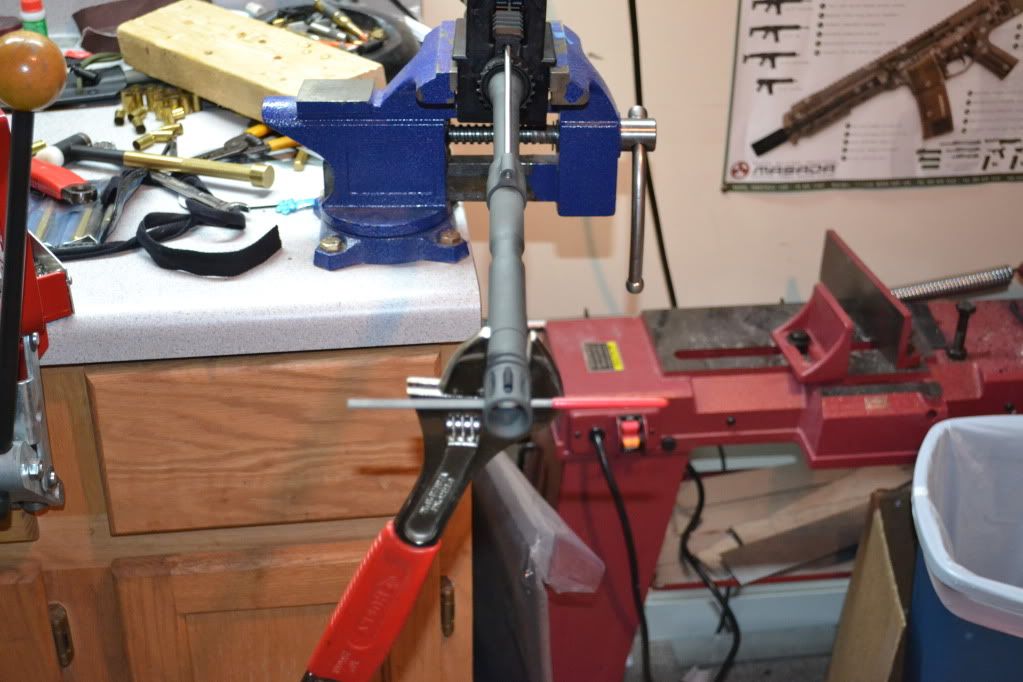
Good to go. Lastly, I installed the rail system and folding sights. The sights are a bo brainer, and for the Troy rail just follow the directions. It's a two piece design that free floats, and it mounts over a standard AR barrel nut with a clamp that uses five screws:
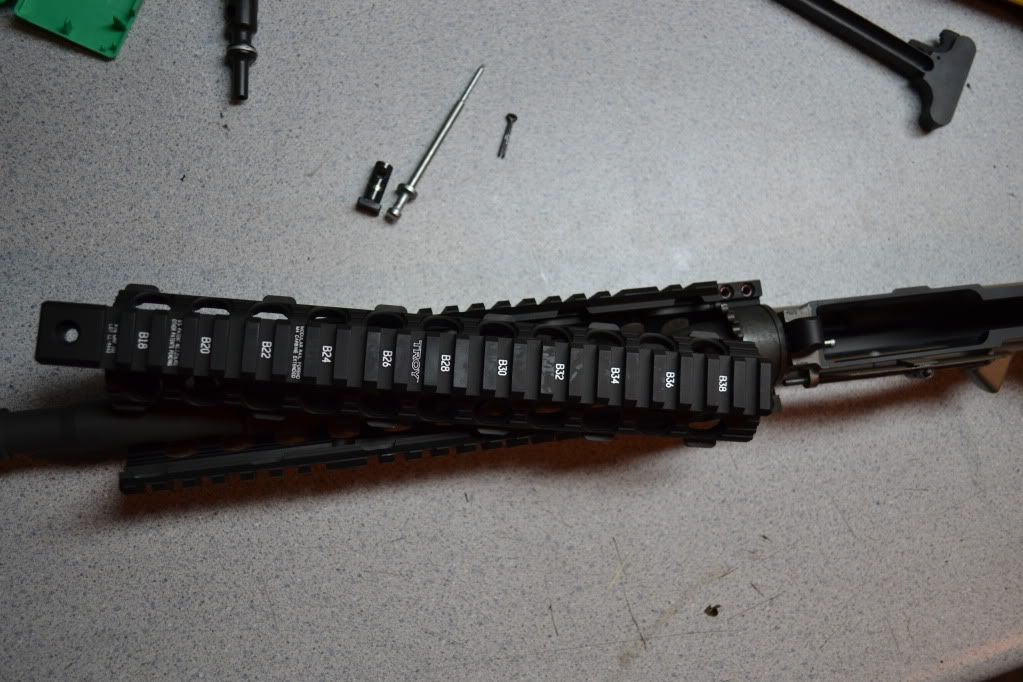

Looking at the above picture, the barrel nut sits down into the top half of the rail, and then the bottom half of the rail (it's facing the wrong way in the picture) snaps into the top half.  You can see that the bottom half has little index tabs on both sides that fit into corresponding slots on the top half.  Once they line up, the bottom half slides towards the receiver about 3/8", which locks the rail's tabs.  There's a strap (it's in the instructions!  Read the instructions!) that runs around the bottom of the barrel nut, connecting the two sections.  I used the maximum recommended torque specs of 60 inch pounds, and it's solid. This rail has an anti-rotation design that fits against the receiver to keep it from turning. It's also not a gazillion dollars like a Knight's Armament rail. Here's a glamour shot of the finished product sans optic, which I will be ordering shortly. It's mounted on my DPMS lower for the
 time being until I build the lower:
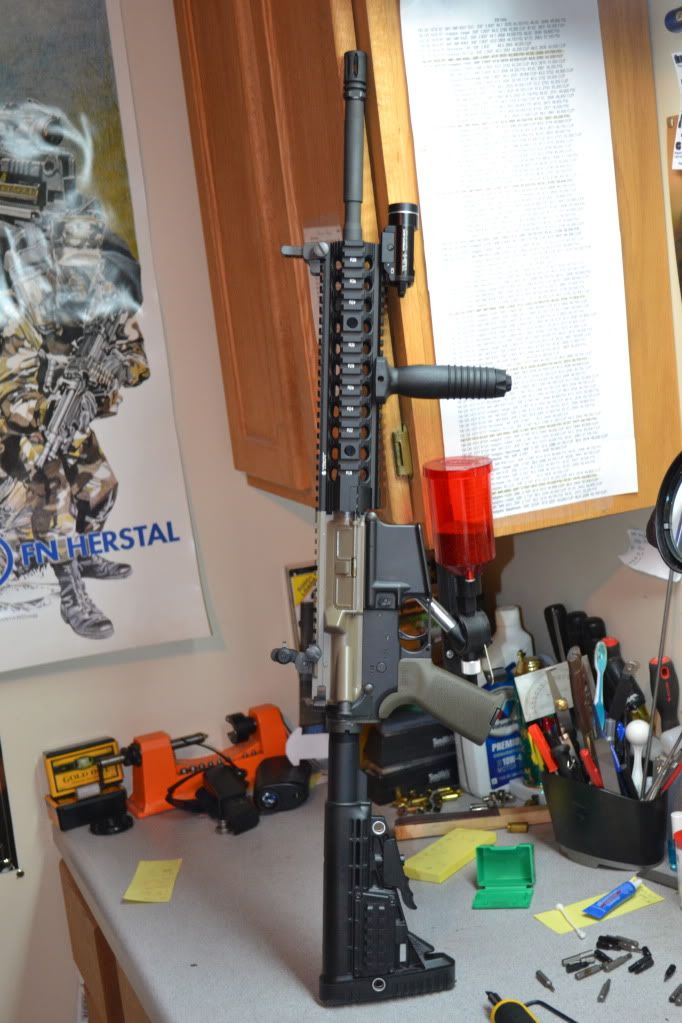

The rail is not as long as the rifle length rail on the little-AR-from-DPMS, but it will work great for its intended purpose:
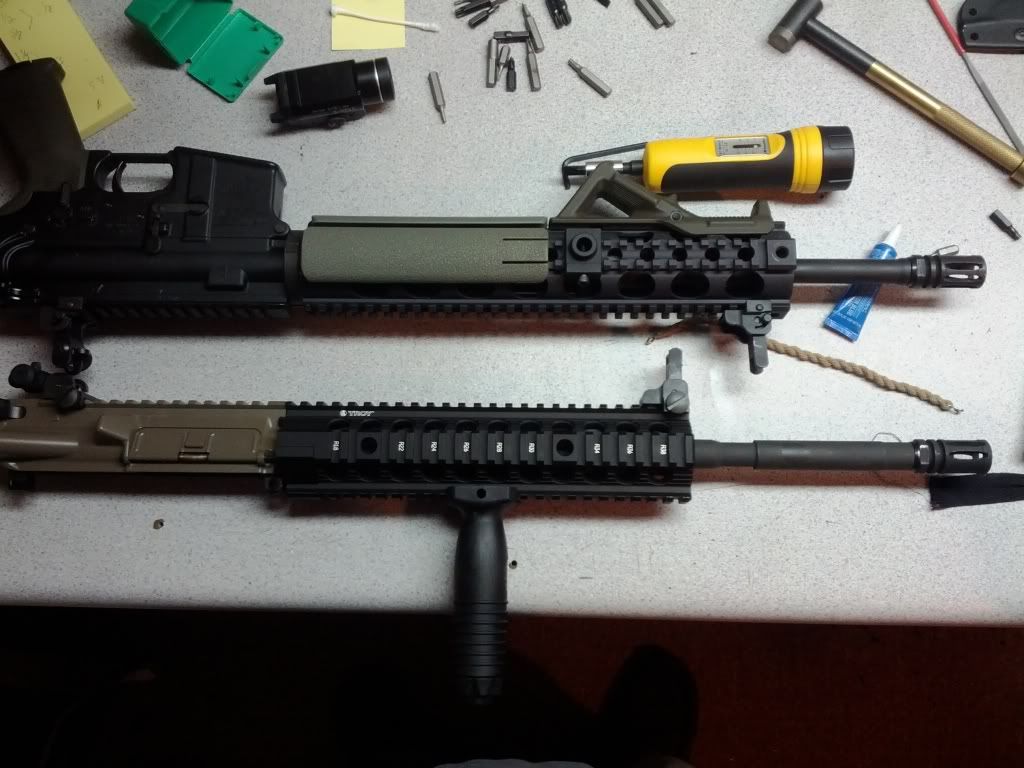

The advantage of using a longer rail on a carbine and putting your front sight way out there is that it gives you a longer sight radius, which translates into more precision available at range. There's also more rails for you to mount kitchen sinks to at that fighting-rifle class you're attending. All in all, putting an AR together is easy. It's also therepudic (if you don't have interuptions, then it's a clown-show). Give it a try sometime!


Monday, May 21, 2012

Open Carry continues to be a non-issue

One individual's account of trying out Open Carry (OC).  There are of course the tactical ninja folks that pooh-pooh not concealing your weapon for one reason or another, but I've always been a big fan. 

The greatest advantage (for me) is comfort; IWB holsters are not nearly as comfy as a leather belt holster, and it's a pain in the ass to wear a jacket all the time.  And it's not only faster to draw from OC than from concealment, there's also less to go wrong with the draw.  Raise your hand if you've ever done concealed draws on a range and had your weapon snag on your clothing or bind up in your hand?  I have, plenty of times; and if you haven't, then you may not have spent much time on the range.  Or maybe I'm just a klutz.  That's a possibility too.  Another bonus is that lots of shooting academies teach from an open holster, not from concealment.  It blows my mind to read after action reviews of some academy where the shooter spend five days and 5,000 rounds shooting from a thigh holster made for Afghanistan operations, and not a carry holster made for WAWA operations. If you're going to war, then by all means, train for war.  If you're going to the mall, then train for going to the mall.

Also, draws and shooting should be practiced from non-traditional and non-static positions, which is easier if you don't have to sweep a jacket out of the way or rip up a shirt to get to your heater.  I'm going to call myself out as a hypocrite on this for the time being because I don't practice what I preach due to time constraints and other stuff, but I plan on getting into a realistic training tempo shortly.  It's important though to know that attacks on people don't generally look like what they do on the CCW shows on TV.  What few fights I've been into never started or ended with me facing an opponent at 7 to 15 yards, giving me time to think; actually, I can't recall a single time where I wasn't on the ground and already the recipient of several blows before I even knew I was in a fight.  This is exactly the argument against OC though, in that a scumbag(s) will take your gun before you know they're there, but I tend to disagree on the likelihood of that happening.  I was far less paranoid back then and had no sense of my surroundings, which is paramount to maintaining a good defense.  I think carrying a weapon necessarily makes me conscious of what's going on around me, and much more so when I'm OCing.

One day in near future I hope to have some realistic training under my belt that includes both CCW and OC.  I'm thinking of something more hands on than what's offered at a traditional range, something resembling this:


I don't plan on ever fighting a drug dealer in the car, specifically because I don't allow drug dealers in my car and am not a LEO, but it is realistic to train for fighting in close quarters.  Training to draw on an approaching scumbag at a mock-up ATM is good too, but there are other areas to improve on.  I also think that those who have never OCed before owe it to themselves to try it out at least temporarily so that they may learn something.  Again, OC makes you think all the more about what is going on around you, and that's more valuable to your defense than any shooting you might do, and you may be surprised that no one around you even notices you're armed.

Tuesday, May 15, 2012

I got 99 parts but a gas tube ain't one

My AR parts arrived from Brownell's yesterday, but the gas tube that I ordered elsewhere did not.  I'm not kidding you when I say that there's an all out run on gun parts right now; just browse Brownell's, MidwayUSA, or Bravo Company and you will see that everything is in the red.  Too bad I still need a bolt carrier.  Last night I started fiddling with this build, but it was against the will of my two youngest sons who screamed at my feet the whole time.  All I got done on it was the installation of the forward assist, and I also reminded myself why you shouldn't coat the barrel with anything before you assemble it: the gas block was essentially painted on, so I had to do a little sanding and tapping with hammer and block of wood to get it off.  I took a teaser pic, but forgot to upload it to my Photobucket account this morning.  I'll see if the wife will upload it for me and I'll post it at lunch.

***Update: The daggone gas tube is in Washington!!  UPS really screwed me on this one.  On their tracking system it says that it should be here by the 21st, which will be eleven days after I ordered it, and having worked for UPS in my youth I can expect it to be bent when I get it.  I'm going to try to find one elsewhere in the meantime.  Ridiculous.

***Update:  A dear friend is bird-dogging a carbine length gas tube for me this week; failing that, he may be able to find one at the Richmond gun show this weekend.  I've been doing more intensive research on an appropriate optic for this beasty, and I've narrowed it down to two choices: an Aimpoint PRO or Burris MTAC.  The Aimpoint comes with a mount, and would be great for 300 yards or closer shooting.  The MTAC is a 1x4 power scope, and would give me slightly lesser close range speed but give me range out to 500 yards.  I have a 30mm Bobro mount already, so that is also tipping me towards the MTAC.  However, I'm not kicking in doors for a living, so any speed gained by the Aimpoint is kinda moot, but I have to consider that I already have a carbine AR that shoots tight out to 500 yards and beyond, and the whole premise behind this build is for a fighting rifle that I can practice with.  I'll make a choice here soon enough.  Until then, some teaser pics:


The lower in the bottom pic is from the little-AR-from-DPMS. Its green motif doesn't match the dark lord operator earth or whatever color it's called, but considering this upper is a mutt I find it a good match. I'll build the lower before too long that will match.  And no, the muzzle pointing at General Patton's head in the picture on the mousepad was a total accident.  Sorry Sir!!

Monday, May 14, 2012

A picture is worth a thousand words

Well then, I have a priceless treasure for you.  I'm a big fan of the Chive, so you'll see these posts every now and then.  Looking at these pics, when you get to number 31, you should have an idea of the environment the Marine Corps M16A4 has to operate in, and why the "sand tests" you see internet fanbois putting their M4geries through don't reflect reality.  Also, pic #52 shows the terrifying M1 Garand Assault Clip that you hear so much about.  Lastly, for the martial artists in the room, the GIF from #22 in this pic thread shows the devastation that a kick can do when it connects properly.  I can't stop watching it; it's like a train wreck.

Thursday, May 10, 2012

Quick like a bunny!

WhoooooooooDoggie!  Order AR parts at the end of lunch and twenty minutes later Brownell's drops an email saying "It's on the truck, hoss!"  That's fast!

Picture time this weekend as I assemble an AR upper!

Check your equipment, and other gunnish things

I"ve temporarily postponed the Savage 7 WSM build in favor of another 16" AR build; my reasoning is that my current little AR is a diamond in the rough, its barrel is far too accurate to use as a carbine, so I'm going to build another carbine and save this one for more prestigious, accurate fire.  I'm going in the opposite direction of Andy's former AR dilema: since I have a 1/9" twist barrel already that shoots bugholes, I bought a 1/7" twist barrel from Daniel Defense to take advantage of heavier bullets that are all the rage these days, with a chrome lined bore and chamber.  My plan to build the entire gun, and then continue on with the Savage 7 WSM build changed last night:

I was researching all the parts I needed for the AR build and suddenly got the hankerin' to fondle an AR, so I start cleaning the little-AR-from-DPMS and noticed this:


One of the gas rings is ate up.  There's no visible damage to the inside of the bolt carrier, and I can replace the rings, but I'm glad I found that before hitting the range again.  Now my home defense gun for the zombie invasion is red-lined, so I pressed the MK12 Mod 0 into service until I can stuff the new DD barrel and bolt into the little-AR-from-DPMS:


The MK12 is much lighter without the scope attached, but the loaded magazines feel way heavier than 5.56 mags.  These hold 25, but I wasn't able to seat the mag unless I downloaded 2 rounds.  If ninjas attack, I don't know what I'll do with such a huge handicap in firepower. . . . hopefully the extra millimeter of bullet size will even the odds!  It's actually the first time I've loaded those mags, having kept them in plastic for the end times in the back of the safe.  For bench work or hunting, the 10 rounders work better and are less cumbersome, and they don't scare the natives as much.

My strategy now is to buy all the parts to assemble an upper with the DD barrel, and I'll re-assemble the little-AR-from-DPMS as it was before with the Burris 2x7 for close to mid range coyote work.  The DD will get either an Aimpoint, or more likely a Burris MTAC 1x4, and will be used for less elegant close range and high volume "marksmanship."  And after that the Savage 7 will get my attention once again.

Sorry about the light posting as of late; I have a whole barrel of monkeys on my back, but I have faith that it will all let up real soon.

Wednesday, May 2, 2012

Fit-testing your ammo

In an update at Mike's Spot on his Citadel 1911, Mike casually notes something of much importance that many folks may not have ever tried before -- fit-testing your ammo.  I'll admit to not always doing this with defensive ammo, but curiously will do it with reloads for plinking, which is backwards.  Having a jacked up round not fire on the range isn't as big of a deal as hearing a "click" when you need a "bang" in a moment of great need, and so checking each and every round that you would potentially stake your life on is a good idea.  In Mike's case, he even found out that his barrel was out of specification and needed the attention of the manufacturer's machinery to make it right, which would be a catastrophe to find out in a gunfight.

To fit-test your ammo, field strip your pistol like you would for cleaning and while you have everything clean and pretty, take your barrel and drop each round of your defensive ammo into the chamber and see if the cartridge seats well; what you're looking for is the case head (bottom of the round, for the layman) is even-steven with the barrel hood.  I really need to snap a few pictures of this to give you a visual.  While you're handling each round, check to make sure the primers are seated properly and that the round looks serviceable.  I've found jacked up rounds before in both target ammo and premium self defense ammo.  Stuff happens with massed produced things and it's your responsibility to make sure your weapon is compatable with the ammo.